Service
A modern website, connected to the systems behind it
This is the fastest way to start working with me. A dated website gets a modern, secure, accessible rebuild, finished in weeks, for clients across Georgia and the Southeast.
It isn’t generic web design. I build sites that work with the systems behind them, not brochures that can’t connect to anything.
I hold my own site to the same standard: it passes WCAG AA contrast checks.
Where it usually starts
Most website projects begin with one of these:
- The site is years out of date, and everyone in the organization knows it.
- Updating a page requires a developer, so updates never happen.
- Forms arrive as email attachments that someone retypes into another system.
- The site can’t meet accessibility obligations, and that risk is getting attention.
- The platform is old enough that security updates have stopped.
- The site and the systems behind it share nothing, so staff move data by hand.
See the work
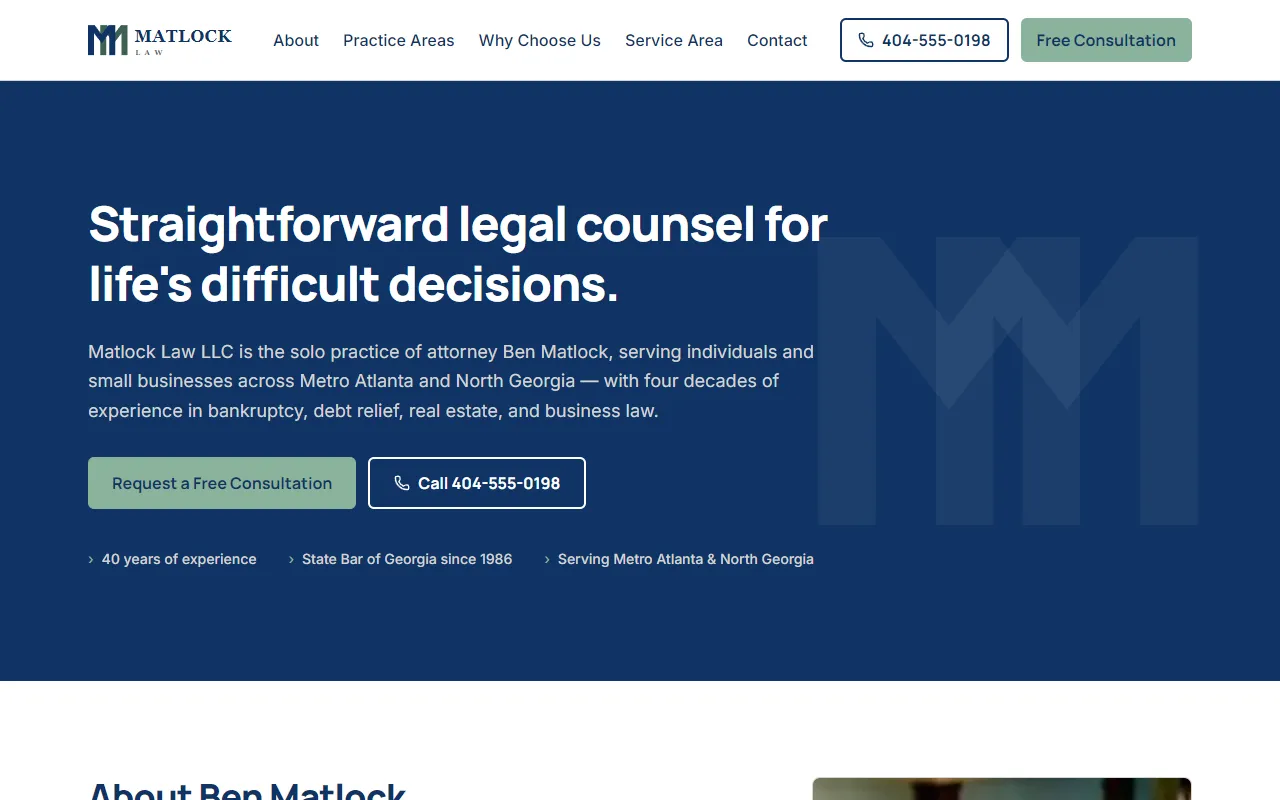
These are live rebuilds you can open right now: a law firm, a nonprofit, and a city. Two of the three portray fictional organizations, and the modernization work behind them is real. Each one carries a white paper on what an aging website risks and what a verified rebuild delivers.


What this looks like for your organization
The build is the same discipline everywhere: modern, secure, accessible, and connected. What changes is the set of systems behind the site.
Businesses
The website as the front of a system, not a brochure. It connects to what runs behind it, with custom work where an off-the-shelf site falls short.
Nonprofits
A site a small team can actually maintain, wired to the tools you already use. Many nonprofit sites sit years out of date because nobody owns them. A redesign should reduce staff load, not add to it.
Cities and counties
A municipal website redesign has to meet ADA and WCAG obligations, so accessibility gets built in from the start, not audited in later. I connect the site to the systems a city already runs: agendas and minutes, GIS, online payments, permitting, forms. Most dated sites can be modernized without a full platform migration.
How I work a website project
- Start with what the site has to do for the organization, not how it looks.
- Inventory the content, the integrations, and the accessibility gaps in the current site.
- Design for accessibility from the start instead of auditing it in later.
- Connect the site to the systems behind it: forms, payments, calendars, maps, records.
- Build on a platform the team you actually have can keep current.
- Set up redirects so the search standing you’ve built survives the launch.
- Document it and hand it over responsibly.
A good first engagement
A website project is bounded and low risk, which makes it a good first engagement. It also tends to surface the deeper workflow and integration problems worth solving next, and that work has a natural home in my software and integration practice.